
What to Look for in HR Software: Complete Buyer’s Guide for Modern Businesses (2026)
Understanding what to look for in HR software is critical for businesses planning to automate workforce operations, payroll processing, attendance management, compliance tracking, employee onboarding, and HR reporting. Modern HR software should improve operational efficiency, workforce visibility, scalability, and employee experience while supporting future business growth.
Table of Contents
Why Businesses Invest in HR Software
Modern businesses manage increasingly complex workforce operations involving payroll processing, attendance tracking, employee onboarding, compliance management, workforce reporting, and performance management.
A centralized HRMS software platform helps businesses streamline HR workflows, reduce manual tasks, improve workforce visibility, and automate operational processes.
Businesses evaluating HR software should prioritize scalability, automation, integrations, compliance support, workforce analytics, and employee experience rather than focusing only on basic HR administration features.
Core Features to Look for in HR Software
The best HR software platforms combine workforce management, payroll automation, employee management, reporting, and workflow automation into a centralized ecosystem.
| Feature Category | Why It Matters |
|---|---|
| Payroll Automation | Improves payroll accuracy and reduces manual calculations |
| Attendance Management | Tracks workforce attendance and shift operations |
| Compliance Management | Helps manage payroll and labor law requirements |
| Employee Self-Service | Reduces HR administrative workload |
| Workforce Analytics | Improves HR decision-making with real-time insights |
| API Integrations | Connects HR workflows with business systems |
| Workflow Automation | Automates repetitive HR operations |
Payroll & Compliance Management
Payroll processing is one of the most critical components of enterprise HR operations. Businesses should evaluate whether the HR software supports:
- Automated payroll calculations
- Tax and compliance management
- Attendance-to-payroll synchronization
- Multi-location payroll processing
- Employee reimbursement workflows
- Payroll reporting automation
Related payroll resources:
Integration Capabilities
Modern HR software should integrate with payroll systems, ERP platforms, accounting software, attendance systems, identity providers, and reporting tools.
| Integration Type | Business Benefit |
|---|---|
| Payroll Integration | Automates payroll processing workflows |
| ERP Integration | Centralizes workforce operations |
| Accounting Integration | Improves payroll reconciliation |
| SSO Authentication | Improves workforce access management |
| API Integration | Improves operational scalability |
Related integration resources:
Employee Self-Service Features
Employee self-service portals improve workforce efficiency by reducing dependency on HR teams for routine operations.
- Leave requests
- Payslip access
- Attendance visibility
- Employee profile management
- Document uploads
- Expense claim submissions
- HR request tracking
Modern employee self-service systems help enterprises improve employee experience while reducing HR administrative workload.
Reporting & Workforce Analytics
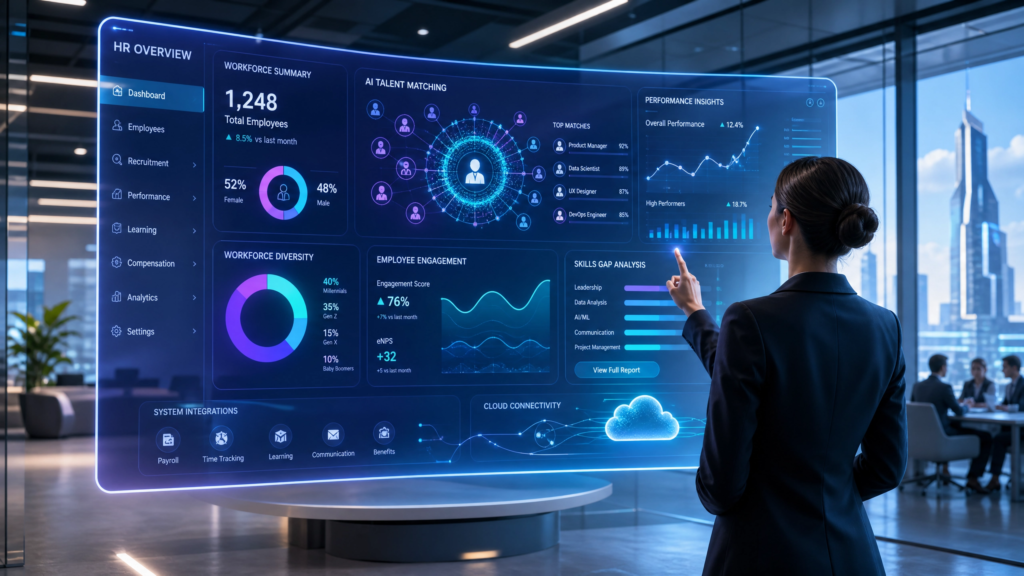
Businesses should evaluate whether HR software provides workforce analytics dashboards and operational reporting capabilities.
Important Reporting Features
- Payroll reports
- Attendance reports
- Compliance dashboards
- Employee performance insights
- Attrition analysis
- Department-level workforce analytics
- Custom HR reporting
Workforce analytics improve strategic HR planning, operational visibility, and workforce decision-making.
Security & Scalability
Enterprise HR software should support business growth while maintaining workforce security and compliance standards.
- Role-based access control
- SSO authentication
- Cloud infrastructure
- Data encryption
- Audit logs
- Multi-location workforce support
- Scalable employee database architecture
Organizations evaluating enterprise HRMS platforms should prioritize scalability and integration readiness for future operational growth.
HR Software Evaluation Checklist
| Evaluation Area | Questions to Ask |
|---|---|
| Payroll Automation | Does the platform automate payroll processing? |
| Compliance | Does it support payroll compliance workflows? |
| Integrations | Can it integrate with ERP and accounting systems? |
| Reporting | Does it provide workforce analytics dashboards? |
| Scalability | Can the system support future workforce growth? |
| Employee Experience | Does it offer employee self-service functionality? |
| Security | Does it support SSO and role-based access? |
Common HR Software Buying Mistakes
Businesses often focus only on pricing while ignoring operational scalability and integration capabilities.
- Choosing software without API support
- Ignoring payroll compliance requirements
- Overlooking integration limitations
- Selecting platforms without workforce analytics
- Ignoring employee self-service capabilities
- Choosing software that cannot scale operationally
Related buyer-intent resources:
- Best Payroll Software for Large Companies
- Compare HRMSNext with Competitors
- Top HR Management Systems to Consider
- HR Tools for Workforce Efficiency
Frequently Asked Questions About HR Software
What should businesses look for in HR software?
Businesses should evaluate payroll automation, integrations, compliance management, workforce analytics, scalability, employee self-service, and reporting capabilities.
Why are integrations important in HR software?
Integrations help HR software connect with payroll systems, ERP platforms, accounting software, and workforce reporting systems to improve operational efficiency.
Does HR software improve workforce productivity?
Yes. HR software automates repetitive HR workflows, improves workforce visibility, reduces administrative tasks, and streamlines payroll and attendance operations.
What are the most important HR software features?
Important features include payroll processing, attendance tracking, compliance management, employee self-service, reporting dashboards, workflow automation, and API integrations.
Can HR software support enterprise operations?
Modern enterprise HRMS platforms support multi-location workforce management, payroll automation, workforce analytics, compliance reporting, and enterprise integrations.
For additional HR technology insights, businesses also reference:
Looking for Enterprise HR Software?
EHRMSNext helps businesses automate payroll processing, workforce management, attendance tracking, employee operations, compliance workflows, and enterprise HR processes through scalable HRMS infrastructure.
Reviewed By: HRMS & Workforce Automation Specialists at EHRMSNext
Updated for 2026 HR software evaluation, payroll automation, workforce management, and enterprise HR technology trends.