Author name: jsburra

How to Choose the Best Payroll System
Blog

How to Choose the Best Payroll System

How to Choose the Best Payroll System in 2026 To choose the best payroll system in 2026, define your payroll requirements, evaluate compliance and automation capabilities, check integrations and reporting, compare pricing and support, and test how well each system fits your payroll workflows. This guide outlines the key steps and criteria for selecting a payroll system and shows how EHRMSNext can fit into a modern payroll strategy. Who This Payroll Selection Guide Is For Organizations moving from manual or basic payroll tools to a modern system HR, finance, and operations teams responsible for payroll accuracy and compliance Businesses planning a payroll or HR technology upgrade in 2026 Summary at a Glance: The right payroll system should automate calculations, meet local compliance needs, integrate with HR and attendance, fit your budget, and be easy enough for HR and finance teams to run confidently every pay cycle. Step 1: Understand Your Payroll Needs Key Takeaway: Start by clarifying what your payroll process looks like today. List how many employees you pay, how often you run payroll, and which countries or states you cover. Identify current pain points: manual calculations, frequent errors, late filings, or complex approvals. Decide whether you want a standalone payroll system or payroll as part of a broader HR platform. Step 2: Define Payroll System Requirements Key Takeaway: Turn your needs into clear functional and compliance requirements. Specify types of pay you handle: regular, overtime, bonuses, commissions, and allowances. Document statutory rules, tax requirements, and reporting obligations in your locations. Note any special cases such as contractors, part-time staff, or multiple entities. Step 3: Build a Payroll Evaluation Checklist Key Takeaway: Use a checklist to compare payroll systems consistently. Evaluation Area What to Check Accuracy and automation Support for your pay types, rules, and calculations with minimal manual work. Compliance Handling of taxes, statutory deductions, filings, and audit trails for your regions. Integrations Connections to HR, attendance, accounting, and banking systems. Employee self-service Access to payslips, tax forms, and personal details for employees. Reporting Standard and custom payroll reports for HR, finance, and leadership. Scalability Support for growth in headcount, locations, and complexity. Support and reliability Service levels, response times, and vendor track record. Step 4: Shortlist Payroll Systems Key Takeaway: Move from many options to a realistic shortlist of systems to evaluate in depth. Use your requirements and checklist to identify 3–5 payroll systems that match your needs. Review vendor documentation and case studies for organizations similar to yours. Remove systems that cannot meet essential compliance or integration requirements. Step 5: Run Demos and Test Workflows Key Takeaway: Test real scenarios, not just high-level feature tours. Prepare sample payroll scenarios, including regular runs, corrections, and year-end activities. Ask vendors to show how your actual attendance, leave, and HR data would flow into payroll. Gather feedback from HR, finance, and relevant managers on ease of use and clarity. Step 6: Compare Pricing, Contracts, and Implementation Key Takeaway: Look at total cost, not just the subscription price. Compare per-employee or per-company pricing, including any add-ons for features or support. Review implementation plans, data migration support, and realistic go-live timelines. Check contract terms, renewal conditions, and exit options if you need to change systems later. Where EHRMSNext Fits as a Payroll System Key Takeaway: EHRMSNext offers payroll as part of an integrated HR, attendance, and compliance platform. Connects attendance and HR data directly with payroll calculations. Supports configuration of earnings, deductions, and allowances aligned to local rules. Provides employee self-service for payslips and basic payroll information. Helps reduce manual effort and provides clearer visibility into payroll outcomes. Is EHRMSNext the Right Payroll System for You? ✅ You want payroll integrated with HR and attendance instead of separate tools. ✅ You are moving away from manual or fragmented payroll processes. ✅ You expect headcount and complexity to grow and need a system that can scale. FAQs: How to Choose the Best Payroll System What are the most important criteria when choosing a payroll system? The most important criteria include accurate calculations, compliance coverage, integrations with HR and accounting, ease of use, reporting, and reliable vendor support. How many payroll systems should we evaluate in detail? Many organizations review several options at a high level, then focus on a shortlist of three to five payroll systems for detailed demos and comparisons. How long does it usually take to implement a new payroll system? Implementation timelines vary, but with clear requirements and data, many organizations can implement a new payroll system within a few months. Should we choose standalone payroll or payroll within an HR suite? Standalone payroll can work if you need only payroll, but an HR suite with integrated payroll can simplify data management and reduce manual steps. How does EHRMSNext help organizations choosing a payroll system? EHRMSNext helps by providing payroll integrated with HR and attendance in one platform, along with configuration options and implementation support aligned to modern payroll and compliance needs.

How to Implement HRMS in 30 Days
Blog

How to Implement HRMS in 30 Days

How to Implement HRMS in 30 Days Implementing an HRMS in 30 days involves a phased approach that includes requirement planning, system configuration, data migration, user training, and a controlled go-live within a fixed timeline. How to Implement HRMS in 30 Days outlines a realistic, step-by-step implementation roadmap that helps organizations deploy an HRMS quickly without compromising accuracy, compliance, or user adoption. Who This Implementation Guide Is For Organizations moving from manual or legacy HR systems HR and payroll teams planning a fast HRMS rollout Businesses with defined HR policies and payroll structures 30-Day Implementation at a Glance: Week 1 focuses on planning, Week 2 on configuration, Week 3 on data migration and testing, and Week 4 on training and go-live. Pre-Implementation Requirements Finalized HR and payroll policies Clean employee master data Dedicated HR and IT stakeholders Defined implementation scope Week 1: Planning and Requirement Mapping Identify HRMS modules to be implemented Map current HR and payroll processes Define approval workflows and roles Finalize implementation timeline Week 2: System Configuration Configure employee structure and departments Set up attendance, leave, and payroll rules Configure approval workflows Enable compliance and statutory settings Week 3: Data Migration and Testing Migrate employee master and historical data Validate payroll and attendance calculations Conduct parallel payroll testing Fix configuration gaps Week 4: Training and Go-Live Train HR administrators and managers Enable employee self-service access Conduct final system validation Go live with HRMS operations Post-Implementation Best Practices Monitor system usage and adoption Collect user feedback Fine-tune workflows and reports Schedule periodic compliance reviews Common HRMS Implementation Risks Incomplete data preparation Unclear scope definition Insufficient user training Lack of ownership and accountability FAQs Can HRMS really be implemented in 30 days? Yes. With clear scope, clean data, and stakeholder alignment, HRMS can be implemented within 30 days. What teams are involved in HRMS implementation? HR, payroll, IT, and leadership teams are typically involved. What happens after HRMS go-live? Post-go-live activities include monitoring, optimization, and ongoing user support. Is data migration mandatory for HRMS implementation? Yes. Accurate data migration is essential for payroll and compliance accuracy. What are the biggest risks in HRMS implementation? Poor data quality, unclear scope, and insufficient training are common risks.

hrms for temp agencies
Blog

How to Automate Payroll End-to-End

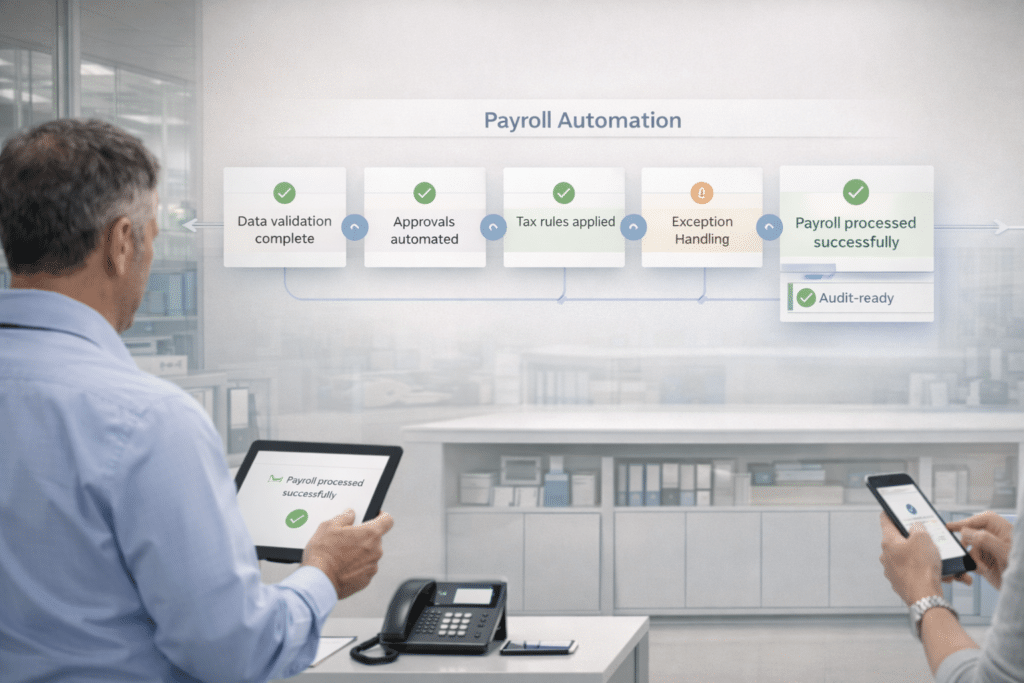
How to Automate Payroll End-to-End in 2026 To automate payroll end-to-end in 2026, connect attendance and HR data into a payroll system, configure earning and deduction rules, automate calculations and approvals, integrate with banking and compliance outputs, and monitor exceptions through clear reports. This guide breaks down payroll automation into practical steps and shows how EHRMSNext can support an automated payroll workflow. Who This Payroll Automation Guide Is For Organizations running payroll with spreadsheets or manual workarounds HR and finance teams seeking fewer errors and faster payroll cycles Businesses planning to modernize HR and payroll processes in 2026 Summary at a Glance: End-to-end payroll automation connects data sources, applies rules consistently, routes exceptions for review, and generates payouts and compliance outputs with minimal manual recalculation. Step 1: Map Your Current Payroll Process Key Takeaway: Start by understanding how payroll works today. List each step from time capture and data collection through approvals, payouts, and reporting. Identify where manual entry, spreadsheets, or repeated checks are required. Note the systems involved today: HR tools, time-tracking, accounting, and banking portals. Step 2: Centralize HR and Attendance Data Key Takeaway: Automation depends on clean, consistent data flowing into payroll. Ensure employee master data, attendance, and leave records are maintained in a central system. Integrate or replace separate tools so payroll can read time and HR data directly. Define clear rules for new hires, exits, and changes that must be reflected before each payroll run. Step 3: Configure Payroll Rules and Policies Key Takeaway: The payroll engine must reflect your real-world earning and deduction logic. Set up earning types, allowances, overtime rules, and deductions that match your policies. Configure statutory tax and compliance rules for each location you operate in. Document exception rules, such as manual adjustments or one-time payouts, and how they should be handled. Step 4: Automate Payroll Calculations and Approvals Key Takeaway: Let the system handle routine calculations while routing exceptions to people. Run test payroll cycles using live attendance and HR data to verify calculations. Set up approvals for key steps, such as overtime, bonuses, or adjustments. Define how exceptions are flagged and who is responsible for resolving them before finalizing payroll. Step 5: Integrate Payouts and Compliance Outputs Key Takeaway: End-to-end automation includes payouts and statutory reporting, not just net pay. Connect payroll outputs with banking files or payment gateways to generate payout instructions. Use the system to produce statutory reports and summaries required for compliance filings. Store payroll and compliance outputs in an auditable, secure location. Step 6: Monitor, Report, and Improve Key Takeaway: Continuous monitoring keeps automated payroll accurate over time. Review payroll reports to track costs, overtime, and error trends. Adjust rules and configurations when policies, headcount, or regulations change. Collect feedback from HR, finance, and managers on where automation can be extended further. Where EHRMSNext Fits in Payroll Automation Key Takeaway: EHRMSNext combines HR, attendance, and payroll so core payroll data and rules are managed in one platform. Connects attendance and leave data directly with payroll calculations. Supports configuration of earnings, deductions, and local compliance rules. Provides employee self-service access to payslips and basic payroll information. Offers reporting that helps HR and finance track payroll outcomes and exceptions. Is EHRMSNext Right for Your Payroll Automation Plan? ✅ You want to reduce manual steps between attendance, HR, and payroll. ✅ You expect headcount and locations to grow and need a system that can handle more complexity. ✅ You prefer a single platform for HR, attendance, and payroll operations. FAQs: How to Automate Payroll End-to-End Which parts of payroll can be automated? Data capture, calculations, approvals, payouts, and reporting can all be automated when HR and attendance data flow into a configured payroll system. Do we need to change our HR system to automate payroll? You do not always need to change HR systems, but you do need reliable integrations or a platform where HR, attendance, and payroll data are connected. How long does payroll automation usually take? With clear requirements and data, many organizations can design, configure, and roll out automated payroll in a few months. What are the main risks when automating payroll? The main risks are incorrect rules, poor data quality, and lack of testing, which can cause errors at scale if not addressed up front. How does EHRMSNext support end-to-end payroll automation? EHRMSNext supports end-to-end payroll automation by linking HR and attendance data with payroll rules, automating calculations, and providing reporting to monitor results.

How to Reduce Attendance Fraud
Blog

How to Reduce Attendance Fraud

How to Reduce Attendance Fraud in 2026 To reduce attendance fraud in 2026, define clear policies, replace manual tracking with a digital attendance system, use controls like biometrics or GPS, run periodic audits, and restrict who can edit attendance data. This guide explains common types of attendance fraud and the practical steps you can take to reduce time theft and manipulation, including how EHRMSNext can help. What Is Attendance Fraud? Employees recording time for colleagues who are not present (buddy punching). Faking locations or using shared devices to mark attendance from unauthorized places. Manual changes to timesheets that are not properly approved or documented. Summary at a Glance: Attendance fraud usually happens where tracking is manual or loosely controlled. Digital systems, clear rules, and regular audits close the gaps that allow fraud to occur. Step 1: Move Away from Manual Attendance Key Takeaway: Manual registers and basic spreadsheets make fraud easier and harder to detect. Replace paper registers and informal spreadsheets with a digital attendance system. Ensure every check-in and check-out is time-stamped and linked to an identified user. Centralize attendance data so HR and managers can review it in one place. Step 2: Use Strong Identity Verification Key Takeaway: Strong identity checks reduce buddy punching and proxy attendance. Use biometric devices (fingerprint or face) or photo-based clock-ins where appropriate. For field and remote teams, use GPS or geofencing to ensure clock-ins happen from approved locations. Discourage shared credentials and enforce unique logins for each employee. Step 3: Define Clear Attendance Policies Key Takeaway: Policy and communication support the technology and make expectations clear. Document what counts as attendance fraud and the consequences of repeated violations. Explain how attendance is recorded, reviewed, and used for payroll and performance. Train managers and employees so everyone understands the rules and the system. Step 4: Limit and Track Attendance Edits Key Takeaway: Fraud often happens through unchecked manual edits. Restrict who can edit or approve attendance records in the system. Require reasons and approvals for adjustments such as missing punches or back-dated entries. Maintain audit logs showing who changed what, when, and why. Step 5: Monitor Patterns and Run Audits Key Takeaway: Regular checks help you catch issues early and discourage manipulation. Review reports for repeated late arrivals, identical clock-in times, or unusual patterns. Schedule periodic audits of attendance data, especially where time theft has been suspected. Use findings from audits to refine rules, approvals, and system controls. Step 6: Connect Attendance with Payroll and Compliance Key Takeaway: When attendance flows directly into payroll, inconsistencies are easier to spot. Integrate attendance data with payroll calculations so hours and pay stay aligned. Use reports to compare expected versus actual hours for teams and locations. Ensure records are kept for compliance and possible legal or internal reviews. How EHRMSNext Helps Reduce Attendance Fraud Key Takeaway: EHRMSNext combines attendance tracking with HR and payroll controls in one platform. Centralizes attendance, leave, and HR data for consistent review. Supports configuration of rules and approval workflows for attendance changes. Links attendance directly with payroll to reduce manual data handling. Provides reporting that highlights patterns and exceptions for HR and managers. Is EHRMSNext a Fit for Your Attendance Control Needs? ✅ You are currently using manual or informal attendance methods. ✅ You need tighter control over time theft and attendance manipulation. ✅ You want attendance to flow directly into payroll with fewer manual steps. FAQs: How to Reduce Attendance Fraud What is the most common type of attendance fraud? One of the most common types is buddy punching, where one employee records attendance for another who is not actually present. Can digital attendance systems completely remove fraud? Digital systems greatly reduce fraud opportunities, but they work best when combined with clear policies, oversight, and regular audits. Do we need biometrics to reduce attendance fraud? Biometrics are very effective for fixed locations, but GPS or app-based methods can also be useful for remote and field teams. How often should we audit attendance records? Many organizations conduct periodic audits, such as monthly or quarterly, and more frequent checks if issues are suspected. How does EHRMSNext support attendance fraud reduction? EHRMSNext helps by centralizing attendance data, enforcing rules and approvals, connecting attendance with payroll, and providing reports to spot patterns and exceptions.

How to Build PTO Policies
Blog

How to Build PTO Policies

How to Build PTO Policies in 2026 To build effective PTO policies in 2026, decide which PTO types you offer, define eligibility and accrual rules, set carryover and encashment guidelines, clarify approval workflows, and configure these rules consistently in your HR system. This guide walks through the main decisions involved in designing Paid Time Off (PTO) policies and explains how EHRMSNext can help you apply those policies in day-to-day operations. What Is PTO and Why It Matters PTO (Paid Time Off) combines different types of paid leave such as vacation, sick days, and personal time into a defined structure. Clear PTO policies help you balance employee wellbeing, compliance, and business continuity. Modern workplaces increasingly use transparent, flexible PTO rules to support retention and productivity. Summary at a Glance: A good PTO policy clearly states who is eligible, how much time off they get, how it accrues and carries over, and how requests and approvals are handled. Step 1: Decide Which PTO Types You Offer Key Takeaway: List the categories of time off you want your policy to cover. Decide whether you will offer a single combined PTO bank or separate buckets for vacation, sick leave, and other types of leave. Consider additional leave types such as parental leave, bereavement, or floating holidays where required by law or company practice. Ensure your choices align with local regulations and cultural expectations in each region you operate. Step 2: Define Eligibility and PTO Amounts Key Takeaway: Clarify who gets PTO and how much they receive. Specify which employee groups are eligible (full-time, part-time, contract), and whether there is a waiting period for new hires. Set standard PTO amounts by role, grade, or tenure, based on your retention and competitiveness goals. Note any region-specific differences where local law mandates minimum leave or additional PTO. Step 3: Set Accrual and Carryover Rules Key Takeaway: PTO rules should explain how time off is earned and what happens if it is not used. Decide whether PTO accrues per month, per pay period, or is granted as a lump sum at the start of the year. Define carryover limits, use-it-or-lose-it rules, or caps on maximum accrual where allowed by law. Clarify what happens at termination: whether unused PTO is paid out and under what conditions. Step 4: Define PTO Request and Approval Workflows Key Takeaway: Simple, visible processes reduce confusion and disputes. Specify how employees should request PTO, how far in advance, and through which system. Assign approvers (managers, HR) and define timelines for approvals or escalations. Document blackout periods or roles where coverage plans are needed before PTO is approved. Step 5: Communicate and Document Your PTO Policy Key Takeaway: A policy only works if people can easily understand and access it. Publish the PTO policy in your employee handbook, HR portal, or intranet in clear language. Include examples where helpful, such as how accrual works over a year or how carryover is calculated. Review the policy with new hires and managers so that expectations are aligned. Step 6: Configure PTO Rules in Your HR System Key Takeaway: System configuration ensures the policy is applied consistently. Set up PTO types, accrual schedules, and carryover rules in your HR or HRMS platform. Align approval workflows and notifications with your documented process. Test the configuration with sample employee records to confirm that balances and accruals behave as expected. How EHRMSNext Helps with PTO Policies Key Takeaway: EHRMSNext connects PTO rules with attendance, HR data, and payroll. Allows you to define PTO types, accrual rules, and carryover settings in one system. Connects PTO balances with attendance and leave requests so managers see up-to-date information. Provides employee self-service so people can view PTO balances and request time off online. Links PTO usage with payroll where necessary for payouts or encashment rules. Is EHRMSNext a Fit for Your PTO Management Needs? ✅ You want clear, system-enforced PTO rules instead of manual tracking. ✅ You manage teams across locations and need consistent PTO handling. ✅ You want employees and managers to see real-time PTO balances and requests. FAQs: How to Build PTO Policies How much PTO should we offer? The amount of PTO you offer should consider legal minimums, market benchmarks, your budget, and your goals for attracting and retaining talent. Should PTO be a single bank or separate types? A single PTO bank can simplify management, while separate buckets for vacation and sick leave may be better where laws or practices require distinction. How do PTO accrual rules usually work? PTO commonly accrues over time (for example, monthly or per pay period), but some organizations grant a full annual allotment at the start of the year. What should we consider for PTO carryover? Consider legal limits, business needs, and employee wellbeing when deciding whether PTO can be carried forward, and if so, how much and for how long. How does EHRMSNext help with PTO policies? EHRMSNext helps by configuring PTO types and rules, connecting them to attendance and payroll, and providing self-service and reporting for employees and managers.

How to Automate Employee Onboarding
Blog

How to Automate Employee Onboarding

How to Automate Employee Onboarding in 2026 To automate employee onboarding in 2026, create digital workflows for pre-boarding, paperwork, IT provisioning, training assignment, and 30/60/90-day check-ins that trigger automatically based on hire date, role, and department. This guide explains how to replace manual onboarding processes with automated workflows and shows how EHRMSNext supports end-to-end onboarding automation. Who Needs Onboarding Automation HR teams buried in repetitive paperwork and follow-ups Companies with high hiring volume or multiple locations Organizations wanting faster time-to-productivity for new hires Summary at a Glance: Onboarding automation handles paperwork, IT setup, training, and check-ins automatically so new hires become productive faster while HR focuses on strategic work. Step 1: Automate Pre-Boarding (Before Day 1) Key Takeaway: Start automation before the employee arrives. Send digital offer letter and e-signature requests automatically upon acceptance Trigger background checks and compliance documents based on role/location Collect emergency contacts, bank details, and tax forms through self-service portals Step 2: Automate Day 1 Setup Key Takeaway: New hires should have everything ready on their first day. Automatically provision email, laptop, software access, and security credentials Assign digital orientation materials, company handbook, and compliance training Schedule manager welcome calls and team introductions through integrated calendars Step 3: Create Role-Based Workflows Key Takeaway: Different roles need different onboarding paths. Role Type Automated Tasks Software Engineer GitHub, Jira, IDE setup, code review training Sales Rep CRM access, sales playbook, pipeline training Marketing CMS, analytics tools, brand guidelines HR Generalist HRIS, payroll system, compliance training Step 4: Automate Training Assignment Key Takeaway: Training should start automatically, not manually assigned. Push mandatory compliance, safety, and role-specific courses to LMS Track completion and block system access until training is finished Automatically certify employees when all required modules are complete Step 5: Schedule Automated Check-Ins Key Takeaway: Don’t rely on managers remembering check-ins. Trigger 30/60/90-day surveys and pulse feedback automatically Schedule manager 1:1 meetings through integrated calendars Escalate at-risk employees to HR based on survey responses Step 6: Integrate Systems for Seamless Flow Key Takeaway: Connect HRIS with IT, LMS, and collaboration tools. HRIS → IT: Automatically create user accounts and assign permissions HRIS → LMS: Push training based on job title and department HRIS → Slack/Teams: Send welcome messages and team channels How EHRMSNext Automates Onboarding Key Takeaway: EHRMSNext handles paperwork, workflows, and system integrations in one platform. Digital forms and e-signatures for offer letters and contracts Automated workflows triggered by hire date and employee type Integrations with IT systems, LMS, and collaboration tools Self-service portals for new hires to complete tasks independently Is EHRMSNext Right for Your Onboarding? ✅ Manual onboarding takes too much HR time ✅ New hires wait weeks for IT access and training ✅ You hire across multiple locations or departments FAQs: Employee Onboarding Automation What should I automate first in onboarding? Start with paperwork and e-signatures, IT provisioning, and compliance training – these deliver immediate time savings and compliance benefits. How long should automated onboarding take? Most organizations aim for new hires to be fully productive within 2 weeks, with core setup completed in first 2-3 days. Do I need to replace my entire HR stack? No, most onboarding automation platforms integrate with existing HRIS, IT, and LMS systems through APIs. Will automation make onboarding impersonal? Automation handles repetitive tasks while preserving human moments like manager welcome calls and team introductions. How does EHRMSNext help with onboarding automation? EHRMSNext automates paperwork, workflows, IT provisioning, and check-ins while integrating with your existing tools.

How to Manage Multi-Country Payroll
Blog

How to Manage Multi-Country Payroll

How to Manage Multi-Country Payroll in 2026 To manage multi-country payroll in 2026, centralize oversight with a unified platform while localizing compliance through country-specific tax rules, currency handling, payment methods, and partner networks that cover statutory filings and labor laws. This guide explains strategies for running payroll across multiple countries and how EHRMSNext supports global payroll operations with local compliance. Why Multi-Country Payroll Is Complex 160+ countries with unique tax codes, filing deadlines, and social security rules Multiple currencies, pay frequencies, and payment methods (bank transfer, cash, mobile) GDPR/CCPA data residency requirements plus local labor law variations Summary at a Glance: Global payroll success requires centralized strategy + localized execution through unified platforms, local experts, and automated compliance monitoring. Step 1: Choose Your Global Payroll Model Key Takeaway: Pick centralized, decentralized, or hybrid based on your scale and needs. Centralized: Single provider/platform manages all countries Decentralized: Local teams handle each country Hybrid: Global platform + local payroll partners (most common) Step 2: Build Country Compliance Matrix Key Takeaway: Document requirements for each country before going live. Country Pay Frequency Tax Filing Social Security USA Bi-weekly Monthly (941) FICA UK Monthly RTI (real-time) NIC India Monthly TDS Monthly PF/ESIC Germany Monthly ELStAM Social Insurance Step 3: Centralize Data & Reporting Key Takeaway: One source of truth across currencies and countries. Unify employee master data, payroll results, and compliance records Convert local currencies to reporting currency for consolidated P&L Generate global headcount, cost, and compliance dashboards Step 4: Automate Compliance & Tax Rules Key Takeaway: Real-time tax table updates prevent penalties. Configure country-specific tax codes, brackets, and deductions Automate statutory filings (W-2, P60, Form 16, P45) Track social security caps and contribution limits per country Step 5: Partner with Local Experts Key Takeaway: Technology + local knowledge = compliance confidence. Global platforms (EHRMSNext) + local payroll bureaus Employer of Record (EOR) for complex markets Legal experts for labor law and contract compliance Step 6: Handle Payments & Currency Key Takeaway: Get employees paid correctly, on time, everywhere. Support local payment methods (ACH, SEPA, UPI, mobile wallets) Manage FX exposure through hedging or payment timing Handle split payments across currencies for expats/remote workers Step 7: Monitor & Audit Continuously Key Takeaway: Compliance is never “set it and forget it.” Real-time compliance alerts for tax rate changes Monthly reconciliation of payroll vs general ledger Quarterly audits of high-risk countries How EHRMSNext Manages Multi-Country Payroll Key Takeaway: EHRMSNext unifies global oversight with local compliance. Country-specific tax tables and statutory rules Multi-currency payroll processing and reporting Local payment method support + bank integrations Compliance dashboards across all locations Is EHRMSNext Right for Global Payroll? ✅ You operate in 3+ countries with different tax/pay rules ✅ Manual payroll reconciliation takes too much time ✅ You need unified reporting across currencies/locations FAQs: Multi-Country Payroll Management Should I centralize or decentralize global payroll? Hybrid works best: centralized platform for oversight + local partners for compliance execution. How do I handle currency conversion risks? Lock exchange rates at payroll cut-off or hedge through forward contracts for predictable costs. What are common multi-country payroll mistakes? Missing tax table updates, inconsistent data formats, ignoring local payment preferences. Do I need local entities in every country? No, Employer of Record (EOR) solutions let you pay legally without local incorporation. How does EHRMSNext support global payroll? EHRMSNext handles multi-country tax rules, currency conversion, local payments, and unified reporting.

How to Improve HR Compliance Accuracy
Blog

How to Improve HR Compliance Accuracy

How to Improve HR Compliance Accuracy Improving HR compliance accuracy involves standardizing HR policies, centralizing compliance data, automating statutory tracking, and conducting regular audits to ensure adherence to labor laws and regulations. This guide explains how to improve HR compliance accuracy using a structured framework that covers common compliance errors, preventive controls, automation, and best practices for consistent regulatory adherence. Who This Is For HR leaders and compliance officers Payroll and operations managers Audit and risk management teams Organizations operating under multiple labor regulations Summary: HR compliance accuracy improves when policies are standardized, data is centralized, compliance is automated, and regular audits are performed. Why HR Compliance Accuracy Matters Prevents legal penalties and regulatory violations Protects employee rights and benefits Improves audit readiness and transparency Reduces operational risk and rework Builds organizational trust and credibility Common Causes of HR Compliance Errors Manual record-keeping and fragmented systems Frequent changes in labor laws Inconsistent policy interpretation Lack of compliance ownership Poor documentation and audit trails Step-by-Step Framework to Improve HR Compliance Accuracy Standardize HR policies and compliance procedures Centralize employee and compliance records Automate statutory tracking and alerts Implement approval workflows and validations Conduct regular compliance audits and reviews HR Compliance Controls That Improve Accuracy Automated compliance alerts and reminders Audit trails for policy and data changes Role-based access controls Version-controlled HR policies Compliance dashboards and reports How Automation Improves HR Compliance Accuracy Ensures consistent application of labor laws Reduces manual errors and omissions Tracks statutory deadlines automatically Maintains real-time compliance visibility Supports audit-ready documentation How to Measure HR Compliance Accuracy Reduction in compliance violations Fewer audit findings and penalties Improved on-time statutory filings Higher compliance reporting accuracy FAQs What is HR compliance accuracy? HR compliance accuracy refers to how correctly an organization follows labor laws, statutory requirements, and HR regulations. Why is HR compliance accuracy important? It helps organizations avoid legal penalties, protect employee rights, and maintain regulatory trust. What causes HR compliance errors? Common causes include manual processes, fragmented data, frequent law changes, and lack of compliance controls. Can HR compliance accuracy be automated? Yes. HR software and HRMS platforms can automate compliance tracking, alerts, and reporting. Who is responsible for HR compliance accuracy? HR compliance accuracy is a shared responsibility among HR, payroll, finance, and compliance teams.

How To Reduce Payroll Errors
Blog

How To Reduce Payroll Errors

How to Reduce Payroll Errors Reducing payroll errors involves standardizing payroll processes, validating employee and attendance data, automating calculations, and performing regular payroll reviews to ensure accurate and compliant salary payments. This guide explains how to reduce payroll errors using a structured payroll accuracy framework, including common causes of payroll mistakes, prevention controls, automation, and best practices. Who This Is For Payroll and HR professionals Finance and accounting teams Compliance and audit managers Organizations aiming to improve payroll accuracy Summary: Payroll errors can be reduced by combining process standardization, automation, data validation, and post-payroll reviews. Common Causes of Payroll Errors Manual data entry and spreadsheet dependency Incorrect attendance or leave records Misconfigured salary structures Changes in tax or statutory regulations Lack of payroll review and approval controls Step-by-Step Framework to Reduce Payroll Errors Standardize payroll inputs and salary structures Validate attendance, overtime, and leave data Automate payroll calculations and deductions Implement approval workflows before payroll runs Perform payroll reconciliation after processing Payroll Controls That Prevent Errors Pre-payroll validation checks Multi-level payroll approvals Exception reports for anomalies Audit trails and access controls Post-payroll reconciliation How Automation Helps Reduce Payroll Errors Eliminates manual calculations Applies statutory rules consistently Integrates attendance directly with payroll Reduces rework and corrections Improves compliance and audit readiness How to Measure Payroll Accuracy Improvements Reduction in payroll corrections and adjustments Lower employee payroll complaints Improved on-time payroll completion Fewer compliance violations or penalties FAQs What are common payroll errors? Common payroll errors include incorrect salary calculations, wrong deductions, overtime mistakes, and delayed payments. How can payroll errors be prevented? Payroll errors can be prevented by standardizing processes, validating data, automating payroll, and performing regular audits. Does payroll software reduce payroll errors? Yes. Payroll software reduces errors by automating calculations, enforcing rules, and integrating attendance and compliance data. How often should payroll be reviewed? Payroll should be reviewed before and after every payroll cycle to identify and correct errors early. Who is responsible for payroll accuracy? Payroll accuracy is a shared responsibility between payroll teams, HR, finance, and system administrators.

Step-by-Step HRMS Migration Guide
Blog

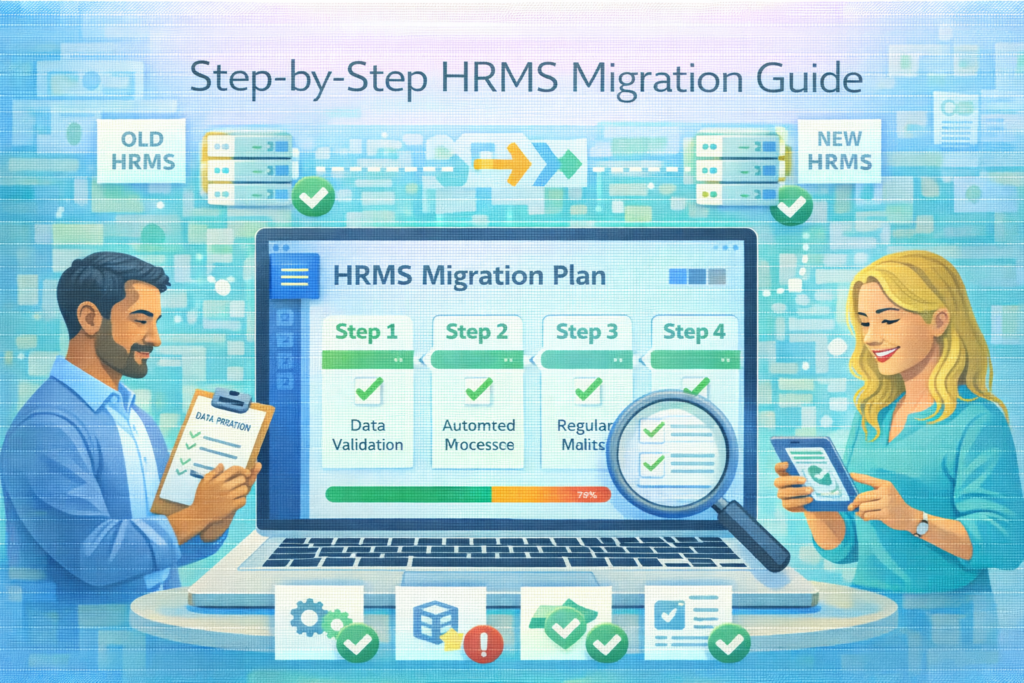
Step-by-Step HRMS Migration Guide

Step-by-Step HRMS Migration Guide HRMS migration is the process of transferring employee data, HR workflows, and payroll operations from a legacy system or spreadsheets to a new HRMS platform while ensuring data accuracy, compliance, and minimal disruption. This step-by-step HRMS migration guide explains how organizations can plan, execute, and validate HRMS migration successfully, including data scope, risks, best practices, and post-migration checks. Who This Is For HR and payroll leaders IT and system administrators Digital transformation teams Organizations moving from legacy HR systems Summary: HRMS migration helps organizations modernize HR operations by moving data and processes into a centralized, automated HRMS platform with minimal risk. What Data Is Migrated During HRMS Migration? Employee master and personal information Job roles, departments, and org structure Attendance, leave, and shift records Payroll history and salary structures Compliance and statutory records Step-by-Step HRMS Migration Process Assess current HR systems and data sources Define migration scope, timelines, and responsibilities Clean, validate, and standardize HR data Configure HRMS modules and workflows Migrate employee and payroll data Test migrated data for accuracy and completeness Train users and prepare for go-live Go live and monitor system performance Pre-Migration Checklist Identify data owners and stakeholders Back up existing HR and payroll data Map legacy data fields to HRMS fields Review compliance and data privacy requirements Set success criteria for migration Common HRMS Migration Risks Data loss or corruption Downtime during payroll cycles Compliance gaps User adoption challenges Integration failures with payroll or attendance systems HRMS Migration vs HRMS Implementation HRMS migration focuses on moving existing data and processes HRMS implementation focuses on configuring and deploying the system Migration is data-centric; implementation is system-centric Both are required for successful HRMS adoption Best Practices for Successful HRMS Migration Start with clean and validated data Run parallel payroll testing before go-live Communicate clearly with all stakeholders Provide training and documentation Monitor post-migration performance closely FAQs What is HRMS migration? HRMS migration is the process of moving HR and payroll data from legacy systems to a new HRMS platform. How long does HRMS migration take? HRMS migration typically takes a few weeks to a few months, depending on data volume and complexity. What data is migrated during HRMS migration? Employee data, payroll history, attendance records, compliance data, and organizational structure are migrated. What are common HRMS migration challenges? Common challenges include data quality issues, downtime risks, compliance gaps, and user adoption. Can HRMS migration be automated? Yes. HRMS migration can be partially automated using migration tools and HRMS import utilities.

Scroll to Top