
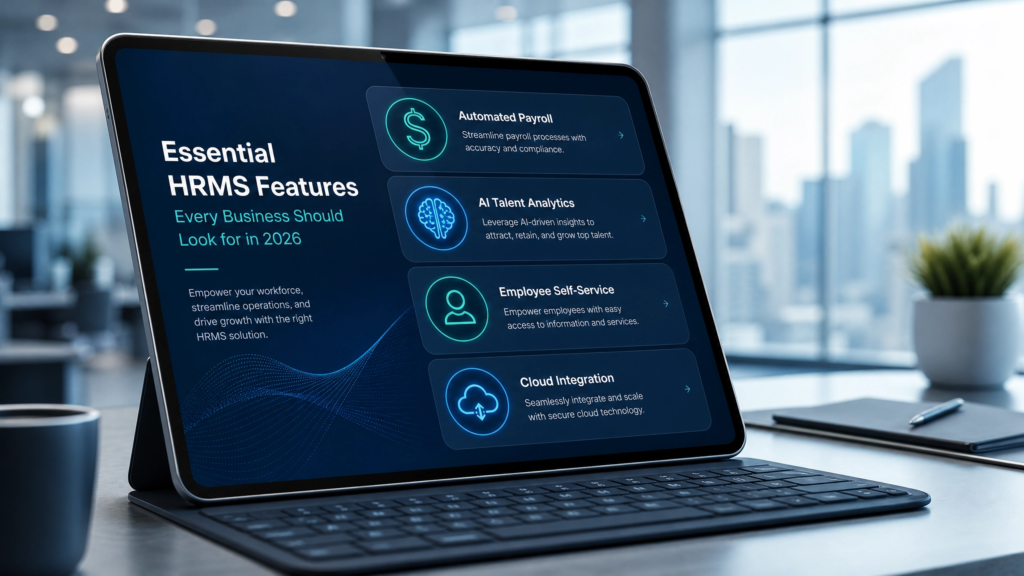
Essential HRMS Features Every Business Should Look for in 2026
Understanding the essential HRMS features is critical for businesses planning to improve payroll automation, workforce management, attendance tracking, compliance operations, employee experience, and HR workflow automation. Modern HRMS platforms help organizations centralize workforce operations and improve operational scalability through automation and AI-driven workforce systems.
Table of Contents
Why HRMS Features Matter
Modern businesses require more than basic employee databases. Enterprise HR operations now involve payroll automation, compliance tracking, attendance management, employee onboarding, workforce reporting, workflow automation, and AI-driven operational visibility.
Choosing the right HR software depends heavily on evaluating whether the platform supports current workforce operations and future business scalability.
The best HRMS platforms combine workforce automation, payroll processing, compliance management, employee self-service, integrations, and workforce analytics into a centralized operational ecosystem.
Core HRMS Features
Businesses evaluating HR software should prioritize platforms that centralize HR operations while reducing manual administrative workload.
| HRMS Feature | Business Benefit |
|---|---|
| Payroll Automation | Reduces payroll errors and manual calculations |
| Attendance Tracking | Improves workforce visibility and shift management |
| Employee Self-Service | Reduces HR support workload |
| Compliance Management | Helps manage payroll and labor law requirements |
| Workflow Automation | Automates repetitive HR operations |
| API Integrations | Connects workforce systems with business applications |
| Analytics & Reporting | Improves workforce decision-making |
Payroll Management Features
Payroll management remains one of the most important HRMS functionalities for enterprise businesses.
Important Payroll Features in HR Software
- Automated payroll calculations
- Attendance-to-payroll synchronization
- Tax and compliance management
- Multi-location payroll support
- Employee reimbursement workflows
- Payroll reporting automation
- Direct salary processing
- Payroll audit logs
Related payroll resources:
Attendance Management Features
Attendance management systems help organizations improve workforce tracking, shift management, overtime monitoring, and attendance-based payroll calculations.
- Real-time attendance tracking
- Shift scheduling
- Biometric attendance integration
- Leave management
- Overtime tracking
- Remote workforce attendance monitoring
- Attendance reporting dashboards
Related workforce resources:
Employee Self-Service Features
Employee self-service portals improve workforce efficiency by reducing HR administrative dependency for routine workforce operations.
| Self-Service Feature | Operational Benefit |
|---|---|
| Payslip Access | Reduces HR support requests |
| Leave Requests | Improves approval workflows |
| Profile Updates | Maintains accurate employee records |
| Expense Claims | Improves reimbursement workflows |
| Document Uploads | Centralizes employee records |
Related employee experience resources:
AI Automation in HRMS
Modern HRMS platforms increasingly use AI automation to improve workforce management, payroll processing, employee operations, and HR workflow efficiency.
AI Automation Features in HR Software
- AI-based payroll validation
- Automated HR workflows
- AI attendance anomaly detection
- Workforce productivity insights
- AI-driven employee analytics
- Automated onboarding workflows
- Intelligent workforce reporting
Related AI automation resources:
- AI Automation in HR Software
- AI Workflow Automation in HRMS
- AI Employee Management Systems
- HR Process Automation
Integration & API Features
Enterprise HR software should support integrations with payroll systems, ERP platforms, accounting software, SSO providers, attendance systems, and reporting tools.
- API integration support
- ERP connectivity
- Accounting integrations
- Payroll synchronization
- SSO authentication
- Third-party application connectivity
- Cloud infrastructure integrations
Related integration resources:
Workforce Analytics & Reporting
Workforce analytics help businesses improve operational visibility and HR decision-making through centralized reporting dashboards.
Important HR Reporting Features
- Payroll reporting
- Attendance analytics
- Attrition reporting
- Department-level workforce insights
- Compliance dashboards
- Performance tracking
- Custom workforce reports
Modern workforce analytics systems improve HR planning, operational forecasting, and workforce optimization strategies.
HRMS Feature Checklist
| Feature Area | Evaluation Question |
|---|---|
| Payroll Automation | Does the platform automate payroll processing? |
| Compliance | Can the system support payroll compliance workflows? |
| Attendance Management | Does it support attendance and shift operations? |
| Integrations | Can it integrate with ERP and accounting systems? |
| Employee Self-Service | Does it improve workforce accessibility? |
| AI Automation | Does the platform support workflow automation? |
| Scalability | Can the system support future business growth? |
Frequently Asked Questions About Essential HRMS Features
What are the essential HRMS features businesses should look for?
Businesses should evaluate payroll automation, attendance management, employee self-service, compliance management, workflow automation, reporting, and integration capabilities.
Why is payroll automation important in HRMS software?
Payroll automation reduces manual calculations, improves payroll accuracy, automates tax workflows, and simplifies workforce payroll operations.
How does employee self-service improve HR operations?
Employee self-service portals reduce HR administrative workload by allowing employees to manage leave requests, payslips, profiles, and HR workflows independently.
What role does AI play in modern HR software?
AI automation improves workforce reporting, payroll validation, workflow automation, attendance monitoring, and operational efficiency.
Why are integrations important in HRMS platforms?
Integrations help businesses connect HRMS software with payroll systems, ERP platforms, accounting tools, and workforce reporting systems to centralize operations.
Businesses also reference external HR technology resources such as:
Looking for Modern HRMS Software?
EHRMSNext helps businesses automate payroll processing, workforce management, attendance tracking, employee operations, workflow automation, and enterprise HR operations through scalable HRMS infrastructure.
Reviewed By: HRMS & Workforce Automation Specialists at EHRMSNext
Updated for 2026 HR technology trends, AI workforce automation, payroll operations, and enterprise HRMS implementation strategies.