
Payroll Integration Platform Guide for Enterprises (2026)
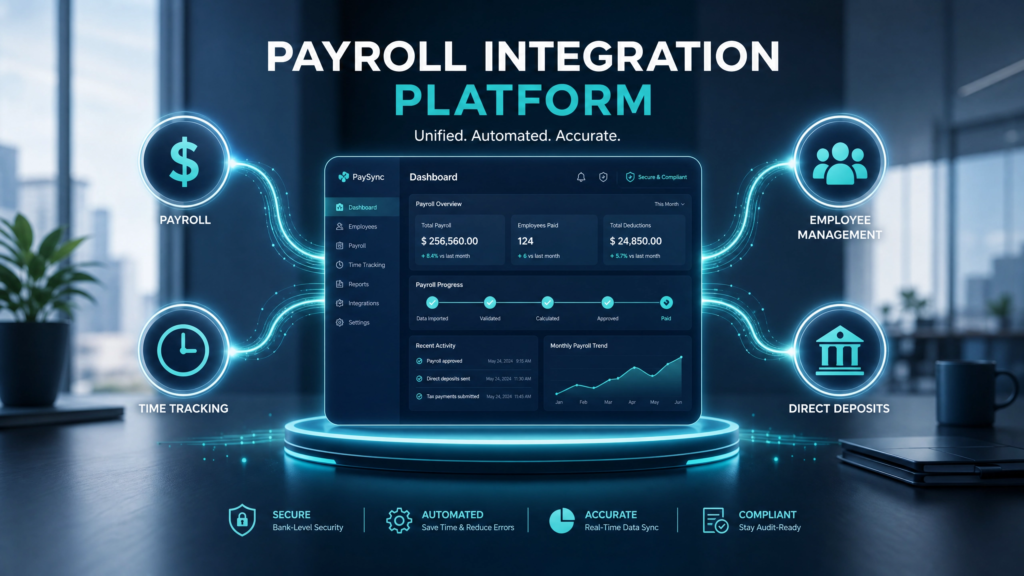
Payroll integration platform solutions help businesses connect payroll software with HRMS, ERP systems, accounting applications, attendance tools, banking platforms, and workforce management systems using APIs and automated data synchronization workflows.
Table of Contents
- What Is a Payroll Integration Platform?
- Why Businesses Need Payroll Integrations
- Core Features of Payroll Integration Platforms
- Common Payroll Integrations
- Payroll API Architecture
- Compliance & Security
- Payroll Integration Implementation Process
- Payroll Migration Playbook
- Payroll Integration Best Practices
- FAQs
What Is a Payroll Integration Platform?
A payroll integration platform is a centralized integration framework that connects payroll systems with HRMS software, ERP applications, accounting tools, attendance systems, identity providers, and workforce management platforms for automated payroll operations and workforce data synchronization.
Modern organizations integrate Payroll Software with workforce systems to reduce manual payroll administration and improve operational efficiency.
Payroll integration platforms commonly support:
- Payroll data synchronization
- Payroll journal automation
- Attendance-to-payroll workflows
- Payroll tax reporting
- Employee payment processing
- ERP synchronization
- Accounting reconciliation
Why Businesses Need Payroll Integrations
As organizations scale workforce operations, disconnected payroll systems create operational inefficiencies and compliance risks.
- Manual payroll workflows reduce efficiency
- Payroll reconciliation consumes operational time
- Disconnected systems create reporting inaccuracies
- Payroll compliance management becomes difficult
- Global payroll operations increase complexity
Organizations implementing payroll integration platforms improve payroll accuracy, workforce visibility, compliance tracking, and financial reporting efficiency.
Core Features of Payroll Integration Platforms
| Feature | Business Benefit |
|---|---|
| API-Based Integrations | Automates payroll synchronization |
| Payroll Compliance Tracking | Improves regulatory visibility |
| Attendance Synchronization | Automates overtime calculations |
| ERP & Accounting Connectors | Improves financial reporting accuracy |
| Multi-Country Payroll Support | Supports global workforce operations |
| Webhook Automation | Enables real-time payroll workflows |
Common Payroll Integrations
HRMS & Workforce Management Integrations
Businesses integrate payroll systems with HRMS platforms to automate employee data management, attendance synchronization, leave tracking, and workforce reporting.
Organizations implementing HRMS with API capabilities improve workforce automation and payroll synchronization efficiency.
Accounting & ERP Integrations
Payroll integration platforms commonly connect with:
- QuickBooks
- SAP ERP
- Oracle ERP
- Microsoft Dynamics
- Xero
Businesses integrating payroll and accounting systems often review:
Attendance & Scheduling Integrations
Attendance integrations automate workforce attendance tracking and payroll calculations.
Organizations using Attendance Management Systems can automate shift tracking, overtime calculations, and workforce scheduling workflows.
Payroll API Architecture
Modern payroll integration platforms rely on REST APIs, OAuth authentication, and cloud-native infrastructure for scalable payroll automation.
API-driven payroll integrations improve:
- Real-time workforce synchronization
- Payroll reporting automation
- Financial reconciliation efficiency
- Cross-platform data visibility
- Enterprise scalability
Compliance & Security
Payroll integrations manage sensitive workforce and financial data, making compliance and security critical.
Enterprise payroll integration platforms should support:
- Encrypted API traffic
- Role-based access control
- Audit logging
- Payroll compliance workflows
- OAuth authentication
- Identity federation
Organizations implementing workforce governance often integrate:
Payroll Integration Implementation Process
1. Audit Existing Payroll Systems
Businesses should review payroll workflows, workforce systems, accounting dependencies, and reporting requirements before integration.
2. Map Payroll Data Structures
Organizations should define:
- Employee data mapping
- Payroll journal structures
- Tax deduction workflows
- Department-level reporting rules
3. Configure API Connections
Integration teams should configure:
- API endpoints
- OAuth credentials
- Webhook triggers
- Synchronization schedules
4. Validate Payroll Synchronization
Businesses should test:
- Payroll accuracy
- Accounting reconciliation
- Attendance synchronization
- Tax reporting workflows
5. Monitor Integration Performance
Organizations should continuously monitor payroll logs, synchronization workflows, and compliance reporting systems.
Payroll Migration Playbook
Pre-Migration Phase
- Audit legacy payroll systems
- Review integration dependencies
- Validate workforce data structures
- Define payroll compliance workflows
Migration Phase
- Configure payroll connectors
- Test payroll synchronization
- Validate accounting workflows
- Run payroll parallel testing
Post-Migration Phase
- Review payroll reconciliation reports
- Monitor API performance
- Validate compliance reporting
- Conduct payroll audits
Payroll Integration Best Practices
| Best Practice | Business Impact |
|---|---|
| Automate Payroll Workflows | Reduces manual payroll tasks |
| Use API Authentication | Improves integration security |
| Validate Data Mapping | Improves payroll accuracy |
| Monitor Payroll Logs | Improves operational visibility |
| Centralize Workforce Systems | Improves payroll reporting |
Businesses modernizing workforce operations increasingly prioritize cloud-based payroll integration platforms to improve workforce automation, compliance management, and enterprise scalability.
Frequently Asked Questions About Payroll Integration Platforms
What is a payroll integration platform?
A payroll integration platform connects payroll systems with HRMS, ERP, accounting, attendance, and workforce management applications through APIs and automated workflows.
Why do businesses need payroll integrations?
Payroll integrations reduce manual payroll administration, improve payroll accuracy, automate reporting workflows, and strengthen payroll compliance management.
Can payroll integration platforms connect with accounting software?
Yes. Payroll integration platforms commonly connect with QuickBooks, SAP, Oracle ERP, Microsoft Dynamics, and other accounting systems.
How do APIs improve payroll integrations?
APIs automate workforce data synchronization, improve payroll visibility, enable real-time integrations, and reduce manual reconciliation workflows.
What security measures should payroll integration platforms support?
Payroll integration platforms should support OAuth authentication, encrypted API traffic, audit logging, role-based access control, and payroll compliance workflows.
Looking for a Payroll Integration Platform?
EHRMSNext helps businesses automate payroll integrations, workforce synchronization, attendance management, accounting workflows, and payroll compliance through secure API-driven HRMS infrastructure.
Reviewed By: Payroll Integration & Workforce Automation Specialists at EHRMSNext
Updated for 2026 payroll integrations, workforce automation, and enterprise payroll infrastructure requirements.