

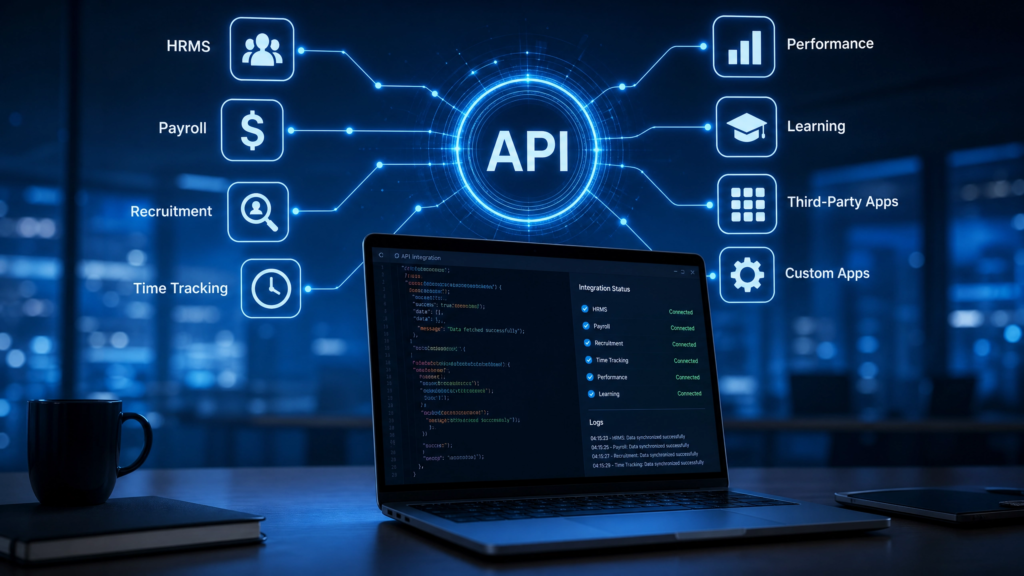
HRMS API Integration Guide for Enterprises (2026)
HRMS API integration enables businesses to connect HRMS platforms with payroll systems, ERP software, accounting applications, attendance systems, identity providers, and workforce management tools using APIs for automated data synchronization and operational efficiency.
Table of Contents
What Is HRMS API Integration?
HRMS API integration allows businesses to securely connect HRMS platforms with external business applications using APIs (Application Programming Interfaces) for automated workforce data exchange and workflow synchronization.
Modern businesses integrate HRMS Software with payroll, ERP, attendance, accounting, recruitment, and identity management platforms to streamline HR operations and reduce manual data entry.
HRMS APIs typically support:
- Employee data synchronization
- Payroll automation
- Attendance tracking integration
- SSO authentication
- Accounting data transfer
- Workforce reporting
- Third-party application connectivity
Why HRMS API Integrations Matter
Businesses increasingly depend on API-driven HR ecosystems to centralize workforce operations and eliminate disconnected systems.
- Reduces duplicate data entry
- Improves workforce data accuracy
- Automates payroll and reporting workflows
- Improves operational scalability
- Supports enterprise automation initiatives
- Reduces implementation complexity
Organizations integrating HRMS platforms with payroll, ERP, and accounting systems improve operational visibility while reducing administrative workload across HR and finance teams.
Common HRMS Integrations
| Integration Type | Business Purpose |
|---|---|
| Payroll Integration | Automate salary processing and payroll calculations |
| ERP Integration | Synchronize workforce and finance operations |
| Accounting Integration | Transfer payroll and expense data automatically |
| SSO Integration | Centralize employee authentication |
| Attendance Integration | Automate attendance-based payroll calculations |
| Recruitment Integration | Sync hiring and onboarding workflows |
Businesses often integrate Payroll Software and Attendance Management Systems with HRMS platforms to streamline payroll operations.
HRMS API Architecture
Most modern HRMS platforms use REST APIs and cloud-based integration architectures to support secure data exchange between applications.
Common API Components
- REST API endpoints
- OAuth authentication
- Webhook support
- JSON payloads
- API access tokens
- Role-based access control
Cloud-based workforce management systems increasingly rely on API-driven integrations for workforce automation and reporting.
Payroll API Integration
Payroll API integrations help businesses automate salary calculations, tax deductions, attendance synchronization, payroll reporting, and employee compensation workflows.
Payroll API integration supports:
- Salary processing automation
- Payroll tax calculations
- Attendance-to-payroll synchronization
- Payroll audit reporting
- Bank transfer workflows
- Employee payslip generation
Businesses using integrated payroll APIs reduce payroll processing errors and improve payroll compliance management.
SSO Integration for HRMS
Single Sign-On (SSO) integration enables employees to securely access HRMS platforms using centralized authentication systems.
Common SSO providers include:
- Microsoft Azure AD
- Google Workspace
- Okta
- Auth0
- OneLogin
SSO integrations improve:
- User authentication security
- Employee login experience
- Access management
- Identity governance
- Enterprise security compliance
ERP & Accounting Integrations
ERP and accounting integrations help businesses synchronize workforce data with financial systems.
HRMS integrations commonly connect with:
- ERP platforms
- Accounting software
- Expense management tools
- Procurement systems
- Financial reporting systems
| Integration | Business Value |
|---|---|
| Accounting Integration | Automates payroll journal entries |
| ERP Integration | Synchronizes workforce and finance data |
| Expense Management | Improves payroll reimbursement workflows |
| BI & Analytics | Enhances workforce reporting visibility |
HRMS Migration Playbook
Businesses migrating from legacy HR systems should follow a structured migration process.
Pre-Migration Phase
- Audit existing HR systems
- Identify integration dependencies
- Map employee data structures
- Review API requirements
Migration Phase
- Configure API connections
- Validate employee data mapping
- Test payroll workflows
- Run parallel payroll testing
Post-Migration Phase
- Monitor integration performance
- Review API logs
- Validate payroll reports
- Conduct integration audits
API Security Best Practices
HRMS integrations manage sensitive workforce and payroll data, making API security essential.
- Use OAuth authentication
- Enable role-based access control
- Encrypt API traffic using HTTPS
- Monitor API usage logs
- Implement token expiration policies
- Conduct regular security audits
Enterprise businesses increasingly prioritize API governance and workforce data protection when evaluating HRMS integration platforms.
HRMS API Integration Implementation Checklist
Before Implementation
- Define integration requirements
- Identify connected systems
- Review API documentation
- Validate security requirements
During Implementation
- Configure API endpoints
- Map workforce data fields
- Test payroll integrations
- Validate SSO authentication
Post Implementation
- Monitor API performance
- Review integration logs
- Track payroll synchronization
- Conduct system audits
Frequently Asked Questions About HRMS API Integration
What is HRMS API integration?
HRMS API integration allows businesses to connect HRMS platforms with payroll, ERP, accounting, attendance, and workforce systems through APIs for automated data synchronization.
Why are APIs important in HRMS platforms?
APIs improve system connectivity, automate workforce workflows, reduce manual data entry, and centralize workforce operations across enterprise systems.
Can HRMS APIs integrate with payroll software?
Yes. HRMS APIs commonly integrate with payroll