

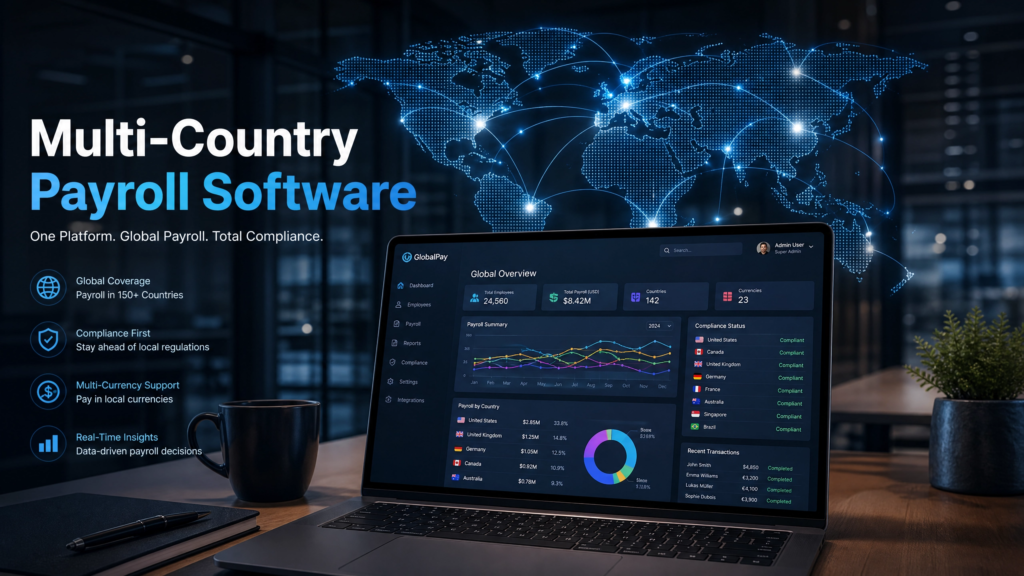
Multi-Country Payroll Software Guide for Global Businesses (2026)
Multi-country payroll software helps global businesses automate payroll processing, manage international payroll compliance, calculate country-specific payroll taxes, handle multi-currency payroll operations, and streamline workforce payroll management across multiple countries from a centralized platform.
Table of Contents
- What Is Multi-Country Payroll Software?
- Why Global Payroll Management Matters
- Common International Payroll Challenges
- Key Features of Multi-Country Payroll Software
- Global Payroll Compliance Requirements
- Country-Specific Payroll Rules
- Benefits of Global Payroll Automation
- How to Choose Multi-Country Payroll Software
- Implementation Checklist
- FAQs
What Is Multi-Country Payroll Software?
Multi-country payroll software is a centralized payroll management platform designed to help businesses manage employee payroll operations across multiple countries while maintaining compliance with local payroll regulations, tax laws, labor requirements, and reporting obligations.
Global businesses use Payroll Software and HRMS Software to automate payroll operations, reduce payroll errors, and improve international workforce management.
Multi-country payroll systems typically support:
- Global payroll processing
- Multi-currency payroll calculations
- Country-specific tax compliance
- Localized payroll reporting
- International employee management
- Global workforce visibility
- Payroll filing automation
Why Global Payroll Management Matters
Managing payroll across multiple countries is increasingly complex due to changing labor laws, tax regulations, employee benefit requirements, and payroll reporting obligations.
- Every country has different payroll laws
- Tax regulations vary significantly across regions
- Currency conversion creates payroll complexity
- Local payroll filing requirements differ globally
- Remote workforce expansion increases payroll challenges
Global organizations increasingly invest in payroll automation to reduce payroll compliance risks and improve workforce operational efficiency across international locations.
Common International Payroll Challenges
Businesses operating globally often face payroll challenges such as:
- Managing country-specific payroll laws
- Handling multiple payroll tax systems
- Tracking international payroll deadlines
- Managing employee benefits across regions
- Coordinating payroll vendors globally
- Maintaining accurate payroll records
- Supporting remote and hybrid workforces
Organizations managing distributed teams often integrate workforce management systems to improve workforce visibility and payroll coordination.
Key Features of Multi-Country Payroll Software
| Feature | Business Benefit |
|---|---|
| Multi-Country Payroll Processing | Centralize payroll operations globally |
| Multi-Currency Payroll | Handle payroll across different currencies |
| Tax Compliance Automation | Reduce payroll compliance risks |
| Localized Payroll Reporting | Meet country-specific payroll reporting obligations |
| Employee Self-Service | Improve employee payroll access |
| Payroll Analytics | Improve payroll visibility and reporting |
Global Payroll Compliance Requirements
Global payroll compliance involves managing payroll regulations across multiple jurisdictions while maintaining accurate payroll calculations and reporting.
International payroll compliance includes:
- Country-specific payroll tax deductions
- Employee classification requirements
- Labor law compliance
- Mandatory employee benefits
- Payroll filing deadlines
- Social security contributions
- Payroll documentation standards
Businesses operating internationally must monitor changing payroll regulations continuously.
Country-Specific Payroll Rules
Every country has unique payroll regulations and compliance requirements.
United States Payroll Rules
- Federal and state payroll taxes
- FLSA overtime regulations
- Payroll tax filing requirements
Read our Payroll Compliance USA Guide .
Canada Payroll Rules
- CPP and EI contributions
- CRA payroll remittances
- T4 payroll reporting
Read our Payroll Taxes Canada Guide .
Brazil Payroll Rules
- INSS and FGTS contributions
- 13th salary requirements
- CLT labor law compliance
Read our Brazil Payroll Rules Guide .
Benefits of Multi-Country Payroll Software
- Centralized payroll operations
- Improved global payroll visibility
- Reduced payroll compliance risks
- Automated payroll calculations
- Faster payroll processing
- Better workforce reporting
- Improved employee payroll experience
Businesses using Employee Self-Service Portals can improve payroll transparency and employee access to payroll records.
How to Choose Multi-Country Payroll Software
Businesses should evaluate multi-country payroll software based on:
- Country payroll coverage
- Compliance automation capabilities
- Payroll reporting features
- Integration capabilities
- Employee self-service functionality
- Payroll scalability
- Security and data protection
| Evaluation Factor | Why It Matters |
|---|---|
| Compliance Automation | Reduces payroll filing risks |
| Localization Support | Handles country-specific payroll laws |
| Scalability | Supports workforce growth |
| Analytics | Improves payroll visibility |
| Integration Support | Connects HR and payroll systems |
Multi-Country Payroll Software Implementation Checklist
Before Implementation
- Identify country payroll requirements
- Review payroll compliance obligations
- Map payroll workflows
- Evaluate payroll vendors
During Implementation
- Configure payroll rules by country
- Integrate HR and payroll systems
- Validate payroll calculations
- Train payroll administrators
Post Implementation
- Monitor payroll compliance
- Review payroll reports regularly
- Track payroll filing deadlines
- Conduct payroll audits
Frequently Asked Questions About Multi-Country Payroll Software
What is multi-country payroll software?
Multi-country payroll software helps businesses manage payroll processing, payroll taxes, and payroll compliance across multiple countries from a centralized platform.
Why do businesses need global payroll software?
Global payroll software simplifies payroll operations, reduces compliance risks, automates payroll calculations, and improves workforce payroll visibility across international locations.
Can multi-country payroll software automate tax compliance?
Yes. Modern payroll platforms automate payroll tax calculations, payroll deductions, payroll reporting, and payroll filing workflows based on country-specific regulations.
What are the biggest challenges in global payroll management?
The biggest challenges include managing country-specific payroll laws, payroll taxes, payroll filing deadlines, employee benefits, and currency conversions.
How does payroll software help international businesses?
Payroll software helps international businesses centralize payroll operations, improve payroll accuracy, automate compliance workflows, and manage distributed workforces efficiently.
Need Help Managing Global Payroll Operations?
EHRMSNext helps global businesses automate payroll processing, payroll compliance tracking, workforce management, payroll reporting, and employee record management through a centralized HRMS platform.
Reviewed By: Global Payroll Compliance Specialists at EHRMSNext
Updated for 2026 international payroll compliance and workforce management requirements.